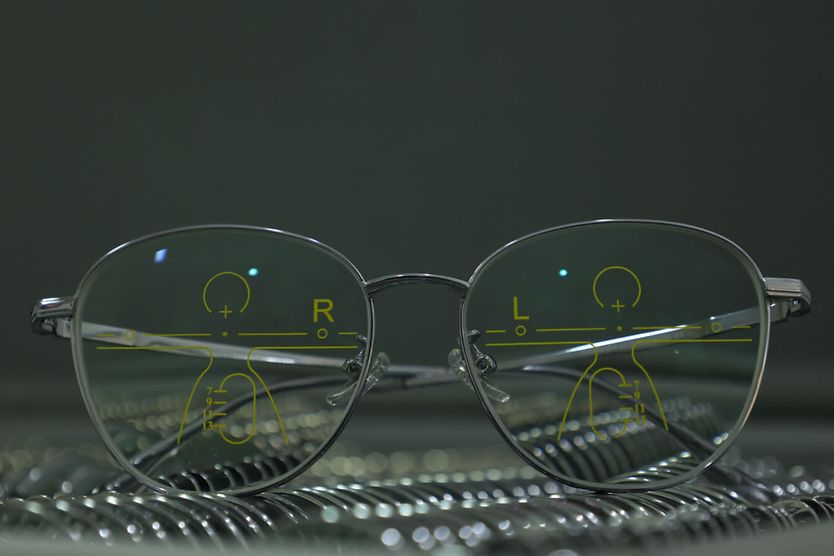
With aspheric eyeglass lenses, thinner lenses are possible.
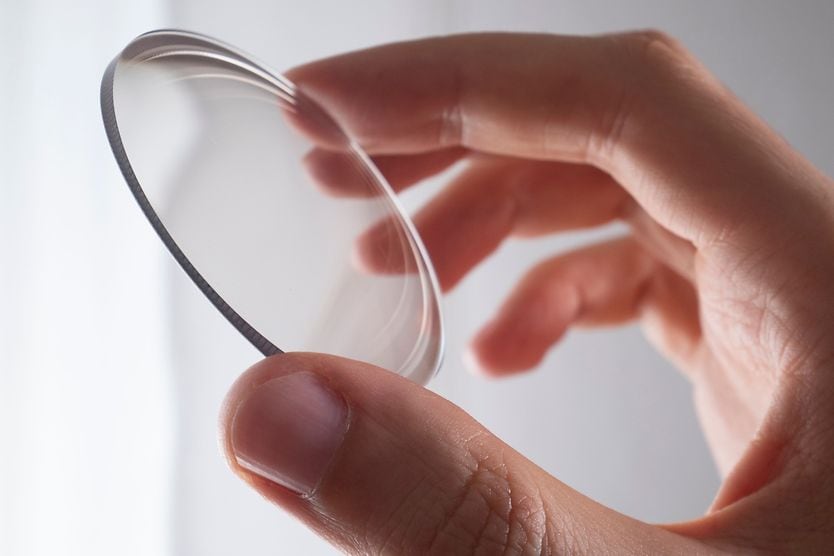
Advanced optical design technology allows aspheric eyeglass lenses to be made with flatter curves than conventional lenses, often giving them a slimmer profile and a slightly different appearance.
Conventional lenses have a front surface that is spherical, meaning it has the same curve across its entire surface, much like a baseball.
Aspheric lenses, on the other hand, have a more complex front surface that gradually changes in curvature from the center of the lens out to the edge.
Aspheric lenses and slimmer profiles
Most aspheric lenses also are high-index lenses. The combination of an aspheric design with high-index lens materials creates a lens that is noticeably slimmer, thinner and lighter than conventional glass or plastic lenses.

Whether you are nearsighted or farsighted, aspheric lenses are thinner and lighter and have a slimmer profile than ordinary lenses.
Aspheric lenses have a slimmer profile for virtually all prescriptions, but the difference is especially dramatic in lenses that correct high amounts of farsightedness. Lenses that correct farsightedness (convex or "plus" lenses) are thicker in the center and thinner at their edge. The stronger the prescription, the more the center of the lens bulges forward from the frame.
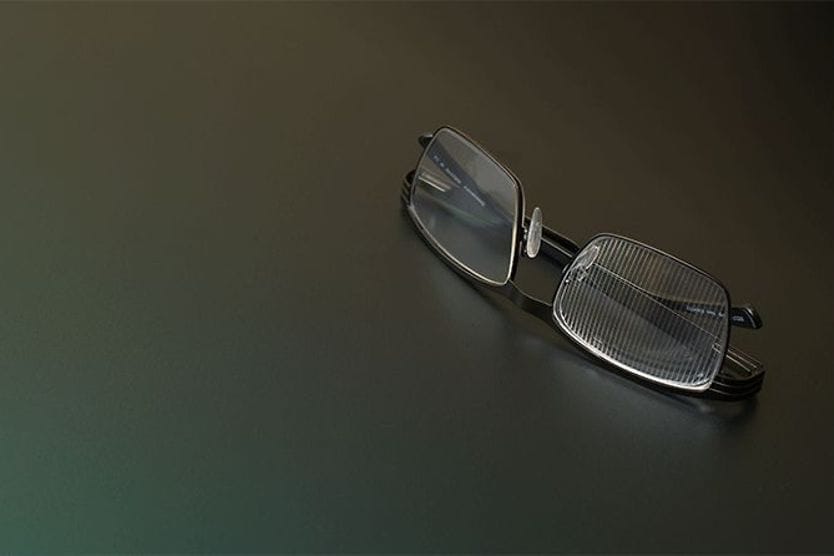
Aspheric plus lenses can be made with much flatter curves, so there is less bulging of the lens from the frame. This gives the eyewear a slimmer profile.
It also makes it possible for someone with a strong prescription to choose from a larger selection of frames without worry of the lenses being too thick for the frames.
Eyeglass lenses that correct myopia (concave or "minus" lenses) have the opposite shape: they are thinnest at the center and thickest at the edge.
Though the slimming effect of an aspheric design is less dramatic in minus lenses, it still provides a noticeable reduction in edge thickness compared with conventional lenses for myopia correction.
Aspheric lenses may improve optics
With conventional lens designs, some distortion is created when you look away from the center of the lens — whether your gaze is directed to the left or right, above or below.
Aspheric lens designs, on the other hand, reduce or eliminate this distortion, which could improve the clarity of peripheral vision. This wider zone of clear imaging is why expensive camera lenses have aspheric designs.
A different view of the world — and your eyes
Because aspheric lenses have flatter curves than conventional lenses, they fit closer to your face. This is often viewed as a benefit for people wearing a strong correction.
Conventional spherical lenses with a strong prescription for farsightedness cause magnification effects. This makes objects appear larger and closer than they actually are. And because this magnifying effect goes both ways, conventional lenses for farsightedness may also make the wearer's eyes look more magnified from the outside.
Conventional lenses for nearsightedness do just the opposite: They make things look smaller and give the wearer's eyes a smaller appearance.
Aspheric lenses may reduce these magnification and minification effects, so the wearer may see a more natural-looking view, and the appearance of their eyes may be closer to their actual size.
Buying eyeglasses with aspheric lenses
Aspheric designs are available in single vision lenses for the correction of nearsightedness, farsightedness and astigmatism, and in progressive lenses, bifocals and trifocals for presbyopia. Although most aspheric lenses are made from high-index materials, they are available in regular plastic, too.
Other enhancements — including photochromic lens technology — are available in aspheric lenses as well.
For several reasons, frame selection is important with aspheric lenses. In general, many wearers prefer when the frame is not overly large and the eyes are centered in the middle of the frame opening. Your eye doctor or optician will help you select the best type of frame to complement your new aspheric lenses.
Taking measurements for aspheric lenses requires greater care and skill on the part of the optician, but this typically requires only an extra minute or two.
Creating the complicated curves used in aspheric lenses often makes these advanced lenses a bit more expensive than conventional lenses. But people may feel that the cosmetic and visual benefits of the thinner, lighter lenses make them a good investment.
Since aspheric lenses are flatter and positioned slightly closer to the face than conventional lenses, some wearers may notice more reflections off the front and back surfaces of the lenses. For this reason, anti-reflective coating is typically recommended for all aspheric lenses.