Progressive lenses: No-line multifocals for a younger you

If you're over age 40 and struggling to see small print with your current glasses, you probably need multifocal lenses.
No worries — that doesn't mean you have to wear ugly bifocals or trifocals. For most people, line-free progressive lenses are a much better option.
Source: All About Vision
What are progressive lenses?
Progressive lenses are no-line multifocal eyeglass lenses that look exactly the same as single vision lenses. In other words, progressive lenses will help you see clearly at all distances without those annoying (and age-defining) "bifocal lines" that are visible in regular bifocals and trifocals.
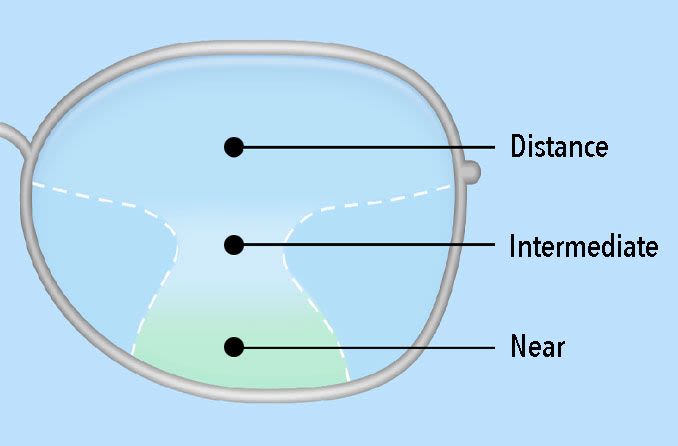
Progressive lenses are line-free multifocals that have a seamless progression of added magnifying power for intermediate and near vision.
The power of progressive lenses changes gradually from point to point on the lens surface, providing the correct lens power for seeing objects clearly at virtually any distance.
Bifocals, on the other hand, have only two lens powers — one for seeing distant objects clearly and a second power in the lower half of the lens for seeing clearly at a specified reading distance. The junction between these distinctly different power zones is defined by a visible "bifocal line" that cuts across the center of the lens.
Progressive lenses sometimes are called "no-line bifocals" because they don't have this visible bifocal line. But progressive lenses have a significantly more advanced multifocal design than bifocals or trifocals.
Premium progressive lenses (such as Varilux lenses) usually provide the best comfort and performance, but there are many other brands as well. Your eye care professional can discuss with you the features and benefits of the latest progressive lenses and help you find the best lenses for your specific needs.
SEE RELATED: Reading glasses vs. multifocal glasses
Progressive lens benefits
Most people start needing multifocal eyeglasses sometime after age 40. This is when a normal aging change in the eye called presbyopia reduces our ability to see clearly up close.
For anyone with presbyopia, progressive lenses have significant visual and cosmetic benefits compared with traditional bifocals and trifocals.
As already mentioned, bifocals have just two powers — one (in the top half of the lens) for distance vision, and a second (in the lower half of the lens) for near vision. Basically, this zone for near vision is the combination of the lens prescription for distance vision plus an added amount of magnifying power to help you see small print and near objects more clearly.
This additional magnifying power is called the near "add" of the bifocal prescription. Typically it's the added power required to enable you to see clearly at a normal reading distance of about 16 inches from your eyes.
Trifocals go one step further — they have a third power for seeing objects clearly at arm's length. This "intermediate" power of a trifocal lens is located in a thin horizontal zone between the distance and near power zones.
Progressive lenses, on the other hand, have many more lens powers than bifocals or trifocals, and there's a gradual change in power from point to point across the surface of the lens.
The multifocal design of progressive lenses offers these important benefits:

It provides clear vision at all distances (rather than at just two or three distinct viewing distances).
It eliminates bothersome "image jump" caused by bifocals and trifocals. This is where objects abruptly change in clarity and apparent position when your eyes move across the visible lines in these lenses.
Because there are no visible "bifocal lines" in progressive lenses, they give you a more youthful appearance than bifocals or trifocals. (This reason alone may be why more people today wear progressive lenses than the number who wear bifocal and trifocals combined.)
Today's premium progressive lenses also are very comfortable to wear. This is especially true of modern "free-form" progressive lenses made with digital design and production tools.
A professional optician can help you select the best progressive lens brand and design for your eyeglasses prescription and your unique visual needs.
Best uses
Progressive lenses are the lens of choice for virtually anyone who needs corrective lenses to see distant objects clearly (due to nearsightedness, farsightedness and/or astigmatism) and also has become presbyopic.
In particular, modern progressive lenses are preferred for anyone who wants the latest technology in multifocal vision correction and also wants the most appealing eyeglasses possible with no old-fashioned lines in the lenses.
There are many brands of progressive lenses, and most brands have several different designs for specific wearers' needs. Seek the services of a knowledgeable optician to be custom-fitted with progressive lenses that best suited to your needs.
Your optician also can give you helpful tips on how to quickly become accustomed to wearing your new progressive lenses and how to care for your eyeglasses to continue seeing clearly and to protect your investment.
Also, for the best clarity, comfort and protection in all lighting, ask your optician about adding anti-reflective coating and photochromic lens treatment treatment to your new progressive lenses.
READ NEXT: What are lenticular lenses?
Page published on Thursday, February 14, 2019