Myopia (nearsightedness): Causes, progression and management

What is myopia?
Myopia (nearsightedness) is a refractive error that causes blurry distance vision. It is the most common cause of impaired vision in people under the age of 40. Myopia usually begins in childhood, but it can continue to worsen into early adulthood. This is called myopia progression.
Almost half of children with progressive myopia reach a stable prescription by age 15. About three-quarters stabilize by age 18, and almost all stabilize by age 24. However, myopia can progress rapidly to become high myopia without proper management. High myopia can lead to sight-threatening complications in adulthood.
SEE RELATED: Pathological myopia
The number of people who have myopia is growing at an alarming rate. In the year 2000, roughly 25% of the world's population was myopic. Research suggests that by the year 2050, roughly half the world’s population will be nearsighted.

What causes myopia?
Myopia (nearsightedness) occurs when the eye focuses light rays in front of the retina, instead of on the retina. This makes distant objects look blurry.
A few different factors contribute to focusing light properly onto the retina:
The length of the eye from front to back
The shape of the cornea and lens
The location of the lens and the cornea relative to each other inside the eye
Small variations in any of these factors can cause myopia.
Emmetropization
In the first years of life, children’s eyes grow and develop rapidly. During this time, the shape of the cornea and lens and the length of the eye come into balance to produce clear vision.
This process is called emmetropization. When there is no refractive error in the eyes, this is called emmetropia.
Most children are born farsighted (hyperopia). This is because the eyes are still too short from front to back at birth.
As the child grows, the emmetropization process continues until around age 6 to 8. At this point, most children have low hyperopia, and only a small percentage have myopia.
Myopia development and progression
In some cases, the process continues. When this happens, the eyes develop past emmetropia and toward myopia. The eyeball may become too long, or the curve of the cornea or lens may become too steep. In rare cases, the lens may move too close to the cornea.
The peak years of myopia progression are often in early childhood. The development and progression of myopia at this age are influenced by several factors, including:
Time spent outdoors
Near work activities (like reading and digital screen time)
A person may have a three times higher risk of nearsightedness if one of their parents is nearsighted. They may have a six times higher risk if both parents are nearsighted.
But recent studies show strong evidence that lifestyle factors may also cause myopia. For example, prolonged near work is associated with higher odds of becoming nearsighted. And spending more time outdoors can delay the onset of myopia.
Types of myopia
Myopia is often divided into two categories depending on its cause: `
Axial myopia is due to the eyeball being too long from front to back (the axial length). It's the most common cause of myopia, especially in childhood.
Refractive myopia can occur if the cornea or lens are too curved. It can also occur if the lens sits too close to the cornea, but this is rare.
Some people can have a combination of axial and refractive myopia.
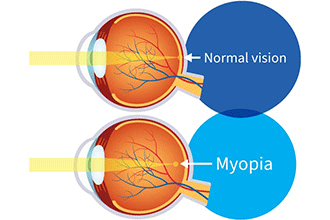
Myopia occurs when light focuses too far in front of the retina.
Myopia symptoms
People with myopia have difficulty seeing distant objects, like road signs, clearly. They usually have better vision during near tasks, such as reading and computer use. This is why myopia is often called nearsightedness.
Other symptoms of myopia include:
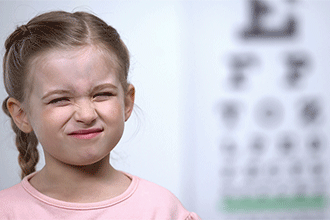
Squinting (partially closing the eyes)
Needing to move closer to see objects clearly
Having difficulty with activities that require good distance vision, like driving or playing sports
If you experience these symptoms while wearing your glasses or contact lenses, schedule an eye exam with your optometrist. You may need a stronger prescription.
SEE RELATED: Bilateral myopia
Myopia management
Myopia management involves all the aspects of eye care a person with myopia may need. It aims to correct blurred vision, control myopia progression and decrease the risk of complications from high myopia. Myopia management includes:
Early detection and diagnosis.
Timely myopia correction and control.
At-home practices like the 20-20-20 rule and limiting screen time.
Addressing any myopia-related complications.
Myopia detection and diagnosis
Early myopia detection and intervention are key in slowing myopia progression. But many kids who are nearsighted won’t have obvious signs and won’t complain of symptoms. If their distance vision has always been blurry, they may not realize anyone else’s is clearer.
This is just one reason that childhood eye exams are so important, even if you haven’t noticed any signs of myopia or other vision problems. The recommended schedule for eye exams for all children is:
First eye exam at 6 months
Another between ages 3 and 5
Another before first grade
Yearly throughout school
Children with a history of myopia risk or who already have myopia may need eye exams more often.
If you or your child need to wear corrective lenses, the eye doctor will tell you the strength of the correction you need. Prescriptions for myopia are written as a minus sign (-) before a number. A higher number indicates higher myopia.
Low myopia ranges from -0.50 to -5.75, and high myopia is -6.00 or greater. High myopia is a concern because it can lead to serious complications. Complications related to high myopia include:
If you are at risk for high myopia, your eye doctor will discuss this with you. They will also check for complications related to high myopia during your exam.
Adults and children diagnosed with myopia need to have regular eye exams to check the degree of their myopia. If the myopia is progressing, early interventions are critical. It is very important to slow myopia progression before high myopia develops.
READ MORE: How to choose an eye doctor
Myopia correction
Myopia can be corrected with optical or surgical methods. Optical methods include standard prescription eyeglasses or contact lenses. Surgical methods include refractive surgery.
Some people with nearsightedness need to wear their glasses or contact lenses all the time. Others might only wear them for specific tasks, such as driving or seeing a chalkboard.
After your eye exam, your eye doctor will talk to you about the exact amount of correction you need. They will also tell you how often you must wear your corrective lenses.
Refractive surgery can reduce or even remove the need for glasses or contact lenses. However, it is not an option for correction until a person's myopia prescription has stabilized. Some of the more common refractive surgeries include:
Implantable lenses known as phakic IOLs
LEARN MORE: LASIK risks and complications
Controlling myopia
More and more people are becoming nearsighted. This means there is a lot of interest in finding ways to control myopia progression in childhood. It is especially important since high myopia can lead to serious vision complications.
Single-vision glasses and contact lenses are usually the first line of correction for myopia. But these standard lenses are not effective in controlling myopia progression.
Recent research shows that wearing specially designed lenses can slow myopia progression. There is evidence that these lenses can slow axial elongation of the eye. In other words, they can slow the rate of the eye growing longer.
For children with progressive myopia, effective myopia control methods include:
Myopia control glasses – Certain bifocal, progressives (PAL) and other specially designed eyeglass lenses can slow myopia progression.
Myopia control contact lenses – Soft multifocal contact lenses and orthokeratology both show success in slowing myopia progression. Multifocal soft contact lenses were originally designed for people with presbyopia. Newer designs of these lenses are being used for myopia control, with good results. Orthokeratology is also known as corneal reshaping therapy. Special rigid gas permeable (RGP) contact lenses are worn overnight to temporarily reshape the cornea during sleep. This provides clear vision during the day without glasses or contact lenses. Studies show that orthokeratology can also be effective in reducing myopia progression.
Atropine eye drops – Eye doctors have used atropine eye drops to help control myopia for a very long time. But a high concentration of atropine in the drops tends to cause side effects like light sensitivity and headaches. Fortunately, low-dose atropine eye drops can also slow myopia progression in children. The lower dose can slow progression at a similar rate as the higher dose with significantly fewer side effects. Some kids, though, don't respond well to atropine drops.
Lifestyle factors – Research shows that spending at least 90 minutes a day outdoors reduces the risk of developing myopia. Parents should also encourage children to take frequent breaks during reading or screen time outside of school work. The exact relationship between near work and myopia is not yet known. But some studies suggest that prolonged near work may be a risk factor for the development and progression of myopia. Habitually holding books, screens and other near work too close to the eyes may also be a factor.
Myopia control strategies can be used one at a time or in combination. Your eye doctor can tell you which methods will have the greatest effect on myopia progression.
When to have an eye exam for myopia
All children should receive regular eye exams, starting when they are around 6 months old. This is important even if there are no symptoms of myopia or other eye issues.
It is important to remember that early intervention is critical. The earlier a child begins myopia control strategies, the better the impact. Slowing myopia progression is key in reducing the risk of sight-threatening complications in adulthood.
LEARN MORE: Global Myopia Awareness Coalition (GMAC)
Myopia FAQs
Q: Myopia vs. hyperopia: What’s the difference?
A: The difference between myopia and hyperopia is that people with myopia have trouble seeing objects far away, and people with hyperopia have trouble seeing up close. To see an object clearly, an image has to focus directly on the retina — kind of like shooting an arrow at a target. With myopia, the image falls in front of the retina, and with hyperopia, the image falls behind the retina.
Q: What does it mean when myopia is bilateral?
A: When someone has bilateral myopia, it means they have myopia in both eyes. The level of myopia may or may not be the same in both eyes; for example, one eye may have a prescription of -1.00 while the other is -1.50. Eyeglass lenses are made and fitted separately based on the prescription for each eye, as long as there is not too big a difference between each eye.
Q: What does it mean to have high myopia?
A: High myopia is the medical term for severe myopia. Usually, a person with high myopia needs a vision prescription of -6.00 or higher. They also typically need to wear vision correction at all times to participate in everyday activities. High myopia increases the chances of developing sight-threatening complications later in life.
Q: Astigmatism vs. myopia: What’s the difference?
A: Myopia occurs when the eye focuses light rays in a single point in front of the retina. This happens if the eyeball is too long, the cornea or lens are too curved, or the lens is too close to the cornea. Myopia causes blurry distance vision. Astigmatism is when light rays are focused in multiple points, in front of and/or behind the retina. This makes vision blurry at all distances. It occurs if the curve of the cornea or lens is uneven, meaning not the same all the way around.
Gretchyn Bailey also contributed to this article.
Global prevalence of myopia and high myopia and temporal trends from 2000 through 2050. Ophthalmology. May 2016.
Emmetropisation and the aetiology of refractive errors. Eye. January 2014.
The correlation between headache and refractive errors. Journal of American Association for Pediatric Ophthalmology and Strabismus. March 2008.
Ametropia in children with headache. Pakistan Journal of Medical Sciences. May - June 2019.
Significance of outdoor time for myopia prevention: A systematic review and meta-analysis based on randomized controlled trials. Ophthalmic Research. March 2020.
Effect of time spent outdoors at school on the development of myopia among children in China: A randomized clinical trial. JAMA. September 2015.
Effect of outdoor activity on myopia onset and progression in school-aged children in northeast China: The Sujiatun eye care study. BMC Ophthalmology. July 2015.
Myopia. The Lancet. May 2012.
Evidence-Based Clinical Practice Guideline: Comprehensive Pediatric Eye and Vision Examination. American Optometric Association. February 2017.
Optometric clinical practice guidelines. Care of the patient with myopia. American Optometric Association. 2006.
Myopia prevention and outdoor light intensity in a school-based cluster randomized trial. Ophthalmology. August 2018.
School-based programme to address childhood myopia in Singapore. Singapore Medical Journal. February 2021.
IMI – Defining and classifying myopia: A proposed set of standards for clinical and epidemiologic studies. Investigative Ophthalmology & Visual Science. February 2019.
IMI – Interventions for controlling myopia onset and progression report. Investigative Ophthalmology & Visual Science. February 2019.
Page published on Thursday, February 28, 2019
Medically reviewed on Wednesday, February 16, 2022