4 common lens coatings for glasses
What are lens coatings for glasses?
Lens coatings are applied to eyeglass lenses to enhance the durability, performance and appearance of your glasses. This is true whether you wear single vision, bifocal or progressive lenses.
If you’re thinking about purchasing new eyeglasses, you might want to consider the following lens coatings and treatments.
Anti-reflective (AR) coating
Anti-reflective coating (also called AR coating or anti-glare coating) is a microscopically thin multi-layer coating that eliminates reflections from the front and back surface of eyeglass lenses.
By doing so, AR coating makes your lenses nearly invisible so people can focus on your eyes, not distracting reflections from your eyeglasses.
Anti-reflective coating also eliminates glare caused by light reflecting from your lenses. With reflections eliminated, lenses with AR coating provide better vision for night driving and more comfortable vision for reading and computer use.
AR coating is highly recommended for all eyeglass lenses, but particularly for polycarbonate and high-index lenses, which reflect more light than regular glass or plastic lenses if anti-reflective coating is not applied.
Also, aspheric lenses, which have flatter curves than regular lenses, often cause more noticeable reflections, so AR coating is highly recommended for these lenses, too. And AR coating is beneficial when applied to the back surface of sunglasses to eliminate "bounce-back" reflections when you are facing away from the sun.
For the best possible comfort in all lighting conditions, eye care professionals usually recommend applying anti-reflective coating to photochromic lenses. AR coating improves light transmission through the lenses for night driving and helps photochromic lenses reduce glare in bright sunlight.
Scratch-resistant coating
No eyeglass lenses — not even glass lenses — are 100% scratch-proof.
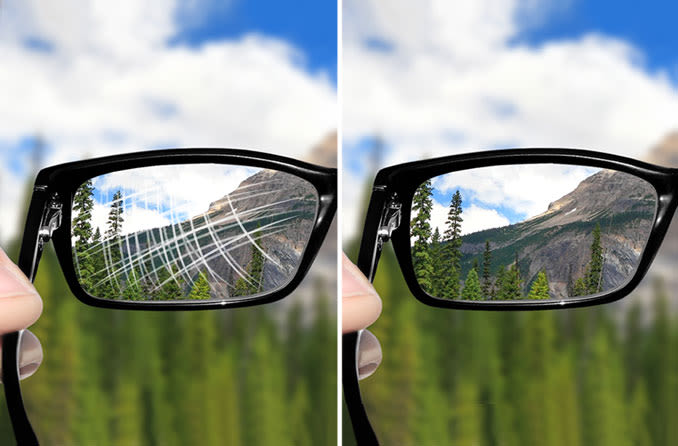
However, lenses that are treated front and back with a clear, scratch-resistant coating have a much harder surface that is more resistant to scratching, whether from dropping your glasses on the floor or occasionally cleaning them with a paper towel.
Kids’ lenses, especially, benefit from a scratch-resistant hard coat for greater durability.
Today, most eyeglass lenses, including high-index lenses and lenses made of polycarbonate and Trivex, have a built-in scratch-resistant coating.
Since scratch-resistant coatings are sometimes optional, make sure your optician knows that you want your eyeglass lenses to include hard coating for extra durability. Also, ask about the warranty on eyeglass lenses that are treated with scratch-resistant coating versus those without the coating.
Keep in mind that even the best scratch-resistant coating can’t completely protect your lenses from wear and tear. To keep your glasses looking new, store them in a cushioned case when not in use, and clean your lenses with a microfiber cloth and the cleaning solution your optician recommends.
Also, be wary of products that promise to repair scratched lenses. These products may fill in the scratches, but it is impossible for them to make the scratches disappear so the lenses look new again.
Anti-fog coating
If you live in a cold climate, nothing is more frustrating than having your eyeglasses fog up when you come in from the cold. This also can be a safety issue, since it limits your ability to see until the fog clears. Lens fogging can be especially dangerous for police officers and other first responders to emergency situations.
At least one eyeglass lens coating company (Opticote) has created a permanent coating designed to eliminate this problem. The factory-applied coating — called Fog Free — eliminates the condensation of moisture on lenses that causes fogging.
So your lenses and vision stay clear when you make the transition from a cold environment to a warm one. It may also keep your lenses from fogging up during sports and other times you are hot and perspiring.
Fog Free can be applied to plastic, polycarbonate and other eyeglass lenses, including high-index lenses and Transitions photochromic lenses. The anti-fog coating is applied to the lenses before they are cut to fit into your frame at the optical lab. Ask your optical retailer about pricing and availability.
Another option in anti-fog lens technology is Optifog lenses.
The anti-fogging property of Optifog lenses is activated by applying a drop of Optifog Activator to each side of the lens, then wiping the lens with a microfiber cloth to thoroughly spread the liquid across the entire lens surface. This treatment keeps the lenses fog-free for up to one week.
Lens fogging is caused by tiny water droplets that form by condensation on the surface of eyeglass lenses when the lenses are significantly cooler than the surrounding air temperature. Optifog works by uniformly spreading these water droplets across the lens surface so they become invisible.
Optifog lenses are available in plastic, polycarbonate and high-index plastic lens materials, with or without EssilorLuxottica’s proprietary Crizal anti-reflective coating.
SEE RELATED: Anti-fog for glasses
Ultraviolet (UV) treatment
Another beneficial lens treatment is an invisible dye that blocks ultraviolet (UV) light. Just as sunscreen keeps the sun’s UV rays from harming your skin, UV-protective treatments for eyeglass lenses block those same rays from damaging your eyes.
Overexposure to ultraviolet light is thought to be a cause of cataracts, retinal damage and other eye problems.
Regular plastic eyeglass lenses block most UV light, but adding a UV-blocking dye boosts UV protection to 100% for added safety. Other eyeglass lens materials, including polycarbonate and most high-index plastics, have 100% UV protection built-in, so an extra lens treatment is not required for these lenses.
Photochromic lenses also block 100% of the sun’s UV rays without the need for an added UV lens treatment.
READ NEXT: Can you further impair your vision with scratched lenses?
Liz DeFranco, ABOC, NCLC also contributed to this article.
Page published on Wednesday, February 27, 2019