UV rays and sunglasses: How to protect your eyes


Protecting your eyes from UV radiation
Ultraviolet (UV) radiation from the sun can damage your eyes, increasing the risk of sight-threatening conditions. Because most of the UV damage is cumulative, it’s important to protect your eyes at every age. Wearing sunglasses with 100% UV protection can reduce this risk and help preserve your vision.
What are ultraviolet (UV) rays?
Ultraviolet rays are a type of electromagnetic radiation that comes from both the sun and man-made sources, such as tanning lamps and other light-emitting devices. Ultraviolet radiation is often referred to as “UV light.” However, you cannot see UV rays like you can other types of light. Ultraviolet rays are relatively short in wavelength and cannot be detected by the human eye.
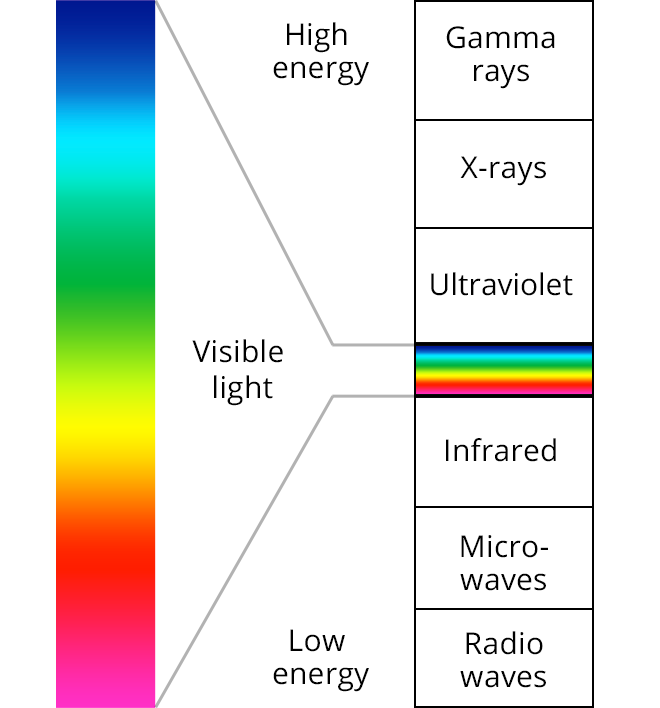
Ultraviolet rays are higher in energy and do not fall within the realm of visible light, as shown here. In the electromagnetic spectrum, radio waves have the lowest energy, and gamma rays have the highest energy.
UV rays are grouped into three main categories based on their wavelengths — which are measured in nanometers (nm) — and the amount of energy they produce. These include UVA, UVB and UVC.
UVA
UVA rays are closer to visible light rays and have lower energy than UVB and UVC rays. They have the longest wavelengths (315-400 nm).
UVA rays can pass through the cornea (the clear, dome-shaped structure at the front of the eye) and reach the crystalline lens. A small amount can potentially reach the retina (the light-sensing membrane at the back of the eye).
These rays can also pass through the middle layer of the skin and increase the risk of skin issues around the eyes, including certain types of skin cancers, sunspots, wrinkles and premature aging.
Much of the UV radiation that reaches the Earth’s surface is UVA.
UVB
UVB rays have slightly shorter wavelengths (280-315 nm) and more energy than UVA rays. They’re partially filtered by the ozone layer, but some still reach the Earth’s surface.
The cornea absorbs most UVB radiation, meaning very little reaches the eye’s natural lens and virtually none reaches the retina. These rays can impact the outer layer of the skin, causing sunburns and increasing the risk of skin cancer. UVB rays can also cause premature aging of the skin.
Some of the UV radiation that reaches the Earth’s surface is UVB.
UVC
UVC rays have the shortest wavelengths (100-280 nm) and contain more energy than UVA and UVB.
The atmosphere’s ozone layer blocks virtually all UVC rays, so not much of it reaches Earth. However, you can still be exposed to this type of radiation through artificial sources, such as welding torches, germicidal lamps and certain lasers. Exposure to UVC radiation can cause severe eye injuries and skin burns.
Measuring ultraviolet rays
In the United States, the risk for UV exposure is measured using the UV index (UVI). The UV index predicts each day’s ultraviolet radiation levels on a simple scale numbered 1 to 11. The higher the number, the greater the risk for UV exposure.
In addition to the UV index daily, a UV Alert is issued when the level of solar UV radiation that day is expected to be unusually high.
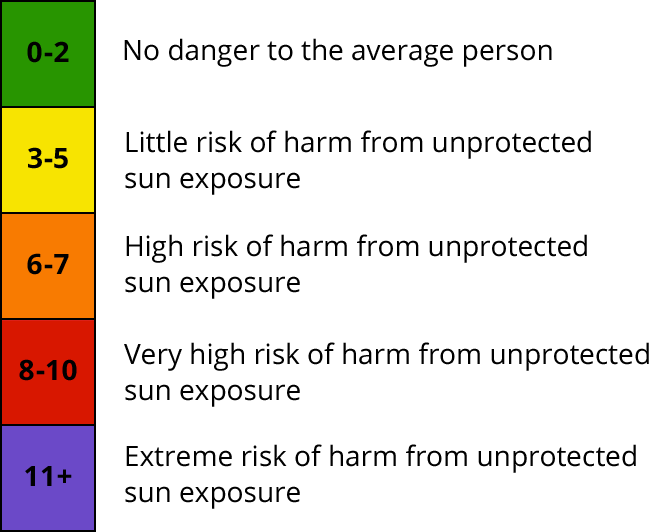
This UV index, devised by the Environmental Protection Agency and National Weather Service, provides a color-coded warning system to alert people to the dangers of being outdoors on certain days.
Factors that increase your UV exposure
Spending time outdoors during the day raises your risk of eye and skin damage from UV radiation. Several factors influence the amount of UV exposure you receive, including:
- Geographic location – UV exposure is greater close to the Earth’s equator. The farther you are from the equator, the lower the risk usually is.
- Altitude – UV exposure is greater at higher altitudes.
- Time of day – UV exposure is the greatest when the sun is high in the sky, typically from 10:00 a.m. to 4:00 p.m. This is especially true in the summer months when the sun’s position in the sky increases UV exposure.
- Environment – UV exposure is generally greater in the presence of highly reflective surfaces, like water, sand and snow. In fact, UV exposure can nearly double when UV rays are reflected from snow.
- Medications – Certain medications, such as tetracycline, sulfa drugs, birth control pills, diuretics and tranquilizers, can increase your sensitivity to UV radiation.
How UV rays can harm your eyes
UV exposure can increase the risk of short- and long-term damage to your eyes and vision. This damage can lead to conditions, such as:
- Photokeratitis – A temporary but usually painful condition in which the cornea and conjunctiva (the clear tissue covering the white of the eye and the inner eyelids) are damaged by intense UV exposure, similar to a sunburn.
- Cataracts – A condition in which the eye’s natural lens becomes cloudy, which can affect your ability to see clearly.
- Eyelid cancers – Occur when skin cancer develops on the eyelid.
- Pinguecula – A white or yellow growth on the conjunctiva, potentially causing irritation and affecting tear function.
- Pterygium (surfer’s eye) – A whitish or pinkish growth beginning on the conjunctiva that may extend to the cornea, potentially affecting vision.
Some studies suggest radiation may play a role in age-related macular degeneration (AMD) development, a condition impacting central vision. It may also increase the risk of certain eye cancers. Further research is needed to better understand these relationships.
How sunglasses protect your eyes from UV rays
The risk of damage to your eyes and skin from solar UV radiation is often cumulative — meaning the danger continues to grow the more time you spend in sunlight throughout your lifetime. To protect your eyes from the sun’s harmful rays. it is recommended to wear sunglasses that offer full UV protection when outdoors. Along with sunglasses, wearing a hat with a wide brim (at least 3 inches) with an ultraviolet protection factor (UPF) 50+ rating and sunscreen can further protect your eyes and the surrounding skin.
Today’s sunglass selections offer a range of features to help keep your eyes safe while spending time outdoors. Many frames can also be fitted with prescription lenses for those who need vision correction.
UV protection rating
The key factor when choosing sunglasses is to ensure they provide the proper UV protection. Look for options with lenses that absorb 100% of UVA-UVB rays. They should contain a label indicating their rating, such as:
- 100% UVA-UVB protection – Absorbs 100% of UVA and UVB rays.
- UV 400 protection – Absorbs up to 400 nm of UV rays.
Lens size and wraparound design
To protect your eyes and as much of the skin around them as possible, it is recommended to choose sunglasses with large lenses or a close-fitting wraparound style. Frames with light-protective side shields can also be effective. Wraparound glasses also minimize UV rays reaching your eyes from the top, bottom and sides of the lenses. For optimal effect, your sunglasses should fit securely and cover the skin around your eyes.
Depending on your outdoor lifestyle, you may also want to explore performance sunglasses or sport sunglasses.
Lens materials
Sunglass lenses come in a variety of materials. Understanding what each type offers allows you to make the ideal choice for your needs:
- CR-39 – A standard plastic material commonly used for sunglass lenses. It naturally absorbs 80% of UV rays.
- Polycarbonate – A lightweight, durable and impact-resistant plastic. Polycarbonate lenses naturally offer UV protection.
- Polyurethane-based lenses– An extremely lightweight, durable and impact-resistant plastic. Polyurethane-based material lenses naturally absorb almost all UV light.
- Glass – Offers superior optical clarity but is often heavier and more likely to shatter. It does not have inherent UV protection properties.
- High-index – A lighter, thinner alternative for people with strong vision prescriptions. High-index lenses can be made of glass or plastic. Their ability to filter UV light is based on the material used to make them.
Sunglass lenses that do not naturally provide full UV protection are typically treated with a coating or have UV-filtering properties built into the lens. However, scratches, wear or other types of lens damage that affect or remove the protective layer can reduce UV absorption, making the lenses less effective at protecting your eyes.
Your eye care professional can help determine the proper lens material for your needs.
Lens tint and treatments
Sunglass lenses also come in a wide variety of lens tints, from yellow to dark gray. However, the amount of UV protection they provide is unrelated to the color and darkness of the lenses. For example, a light amber-colored lens can provide the same UV protection as a dark gray lens. Regardless of which tint you choose, your sunglasses should still offer 100% UV protection.
Other lens treatments and options include:
- Polarized lenses – While most polarized lenses provide UV protection, it’s not always a guarantee. Polarized lenses filter horizontal light to reduce glare from reflective surfaces, such as water, sand, snow and concrete. If you choose polarized lenses, it is recommended to make sure they also offer full UV protection.
- Mirrored lenses – Lenses with a metallic or mirrored finish can reduce the amount of light that reaches your eyes. However, this coating doesn’t filter UV light. If you choose this option, it is recommended to check to make sure they contain the UV label.
- Photochromic lenses – These light-adjusting lenses automatically darken when exposed to sunlight and lighten when indoors. Many photochromic brands offer 100% UV protection, but it’s suggested to confirm this before purchasing.
UV protection for children
Children generally spend much more time outdoors than adults. In fact, some researchers say that because children tend to spend significantly more time outdoors, most of a person’s lifetime exposure to UV radiation can occur before they turn 18.
Children are often more susceptible to eye damage from UV rays because the lens inside a child’s eye is clearer than an adult’s, enabling more UV to penetrate deep into the eye. Their pupils are also larger, letting more light pass through to the retina.
With this in mind, it’s especially important to protect your child’s eyes from the sun by having them wear a pair of UV-protected sunglasses.
When choosing sunglasses for children, consider those with lenses made of polycarbonate or polyurethane-based material. These are often recommended for children due to their inherent UV protection and impact resistance. Encourage your child to wear a wide-brimmed hat and apply sunscreen to their skin to further reduce their UV exposure. Try to avoid being outside on those days and times when UV exposure risk is the highest.
SEE RELATED: Do babies need to wear sunglasses?
Tips for choosing and using sunglasses
There are many misconceptions about protecting your eyes from the sun. To help you make the preferred choice for your needs, keep the following tips in mind:
- Not all sunglasses block 100% of UV rays. If you’re unsure about the level of UV protection your sunglasses provide, take them to your eye care professional for an evaluation. Many providers have instruments that can measure the amount of UV radiation your lenses block.
- Dark lenses don’t automatically provide UV protection. The lenses still need to filter 100% of UVA and UVB rays to keep your eyes safe.
- Wearing dark lenses without UV protection can be more dangerous than wearing no sunglasses at all. The pupils dilate in darkness or dim lighting, allowing more light to enter the eyes than would occur without the sunglasses. This can increase your exposure to UV rays and the risk of eye damage.
- It’s important to wear sunglasses, even on cloudy days and in the shade. Although overcast skies and shade reduce your UV exposure to some degree, your eyes are still exposed to UV rays reflected from buildings, roadways and other surfaces. As much as 89% of the sun’s UV rays can pass through the clouds and reach your eyes, depending on the amount of cloud coverage.
- Sunglasses are also important in winter. Snow on the ground can reflect up to 80% of ultraviolet rays, nearly doubling your overall exposure to solar UV radiation. If you ski or snowboard, choosing the ideal lenses is important for adequate UV protection on the slopes.
- Even if your contact lenses block UV rays, it is still recommended to wear sunglasses. UV-blocking contacts shield the part of your eye under the lens. UV rays can still damage your eyelids and other tissues not covered by the lens.
- If you have dark skin and eyes, sunglasses are still recommended. Although having dark skin color may lower the risk of skin cancer from UV radiation, your risk of eye damage can be the same as that of someone with fair skin. While the risk of skin and many eye cancers can vary based on how much skin pigment someone has, everyone can be at risk and should take protective steps.
Keeping your eyes safe in the sun
Many people enjoy a sunny day. But it’s important to take steps to protect your eyes from the sun. Remember to wear sunglasses with 100% UV protection, a wide-brimmed hat and sunscreen to help keep your eyes and skin safe when spending time outdoors.
Your eye care provider is a preferred resource for choosing the preferred sunglasses for you or your child. They can help you select the ideal lens material, treatments or other options to meet your vision needs.