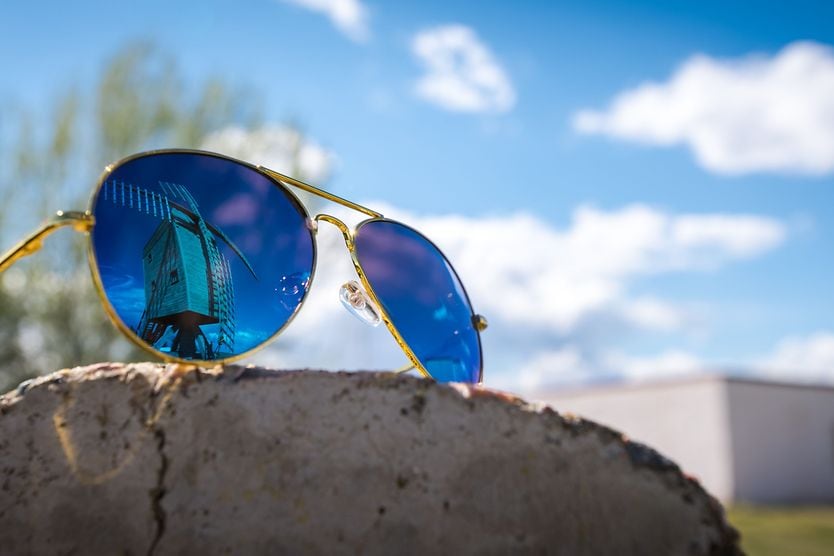
Aviator glasses are a true classic. With their distinctive design — the thin metal frame, double bridge and teardrop-shaped lenses — they’re arguably the most recognizable eyewear style in the world. Also known as pilot glasses, they have been around for nearly a century, ascending from American test pilots to Hollywood stars and becoming a timeless style accessory.
In this ultimate guide, we’ll take you through everything you need to know about aviator glasses: the history behind them, who’s worn them, who should wear them, who makes them, available styles and more.
New heights of aviation
The beginnings of aviator glasses, as the name suggests, are tied to pioneering advancements of aviation. In the early 1900s, in the wake of World War I, daring test pilots began to fly ever higher and faster into the sky.
As speed and altitude records were being broken, new problems arose: Many pilots were reporting that the glare from the sun was causing them to experience headaches and nausea. In an effort to defend themselves against the blinding sunlight and temperatures as low as minus 80 degrees Fahrenheit, they sought to protect their eyes with fur-lined goggles.
But when, in 1920, Capt. Rudolph “Shorty” Schroeder pushed his biplane up above 33,000 feet, his goggles fogged up, leaving him with no other choice than to remove them. Within minutes, his eyes were frozen over.
Amazingly, Schroeder managed to safely land his plane. When U.S. Army Air Corps Lieutenant John Macready pulled him out of the cockpit, he was shocked to see Schroeder’s badly swollen and bloodshot eyes.
Haunted by this image, Macready decided that something needed to be done to protect pilots’ eyes from the harshness of the elements high above the clouds. He partnered with a medical equipment manufacturer to develop special aviation goggles. Those goggles eventually morphed into glasses, and so aviator sunglasses were born.
From pilots to the public
By the late 1930s, the first iteration of aviator sunglasses promised “real scientific glare protection.”
They featured a plastic frame with large, teardrop-shaped lenses that ran along the cheek line and effectively covered two to three times the size of the eye socket. The green lenses were designed to block out light without obscuring pilots’ vision.
Although developed for pilots, they weren’t initially labeled aviator sunglasses when they went on sale to the public in 1937. Instead, they became popular for use in outdoor activities including fishing, hunting and golf, which led to the introduction of new models, including aviator shooting glasses.
In 1938, a shooting model was released in both the green lens and a pale yellow lens designed to sharpen detail and minimize haze. The yellow lens filtered out blue light, which made it ideal for misty conditions.
Meanwhile, another model for outdoor enthusiasts launched the following year in 1939. It featured a signature middle circle “cigarette holder” in the bridge to free the shooter’s hands.
A World War II icon
During World War II, aviator sunglasses became standard gear for U.S. Army Air Forces pilots, mechanics and aviation personnel. Continued research and development resulted in innovations such as the gradient mirrored lens. A special dark coating on the upper part of the lens enhanced sun protection, and an uncoated lower lens gave pilots a clear view of the plane’s instrument panels.
At the height of World War II, aviator sunglasses became a distinctive symbol of military style after renowned General Douglas MacArthur was photographed wearing them during the landing on a beach in the Philippines. The photograph was printed in newspapers across the U.S. and became a defining image of World War II.
Shortly afterward, aviator sunglasses became a hit among civilians. Decades later, in 1987, the company launched an entire line of aviator sunglasses in tribute to General MacArthur.
From function to fashion
With the rise of military influence on everyday fashion from the late 1940s onward, the appeal of aviator sunglasses gained momentum. This continued through the 1950s, largely thanks to stars like Marlon Brando, who wore them in a 1958 movie as an unmistakable fashion statement.
Transitioning from function to fashion, aviator sunglasses quickly turned from military eyewear to the epitome of cool.
To keep up with consumer demand, they continued to update the classic military model with new releases, such as the 1957 square version of the classic frame. In 1976, this version was later worn by Robert De Niro in a movie.
In 1958, a dedicated women’s line was introduced, including frames in different colors with decorative flourishes such as rhinestones. It was then that the aviator sunglasses’ ascent from practical eyewear to an aspirational style accessory truly began.
Celebrity style
The rise of aviator sunglasses continued through the 1960s and 1970s as film stars and musicians could often be seen wearing them. Rock star Iggy Pop wore clear aviator glasses, and Elvis Presley donned kitschy gold-frame aviator sunglasses. David Bowie chose cool dark lenses.
Paul and Linda McCartney wore matching pairs in a family portrait with their kids. Queen frontman Freddie Mercury was photographed sporting a white vest and nonchalantly looking over his shoulder, his aviator sunglasses’ dark lenses reflecting the sunlight.
The style was everywhere and became as iconic as the people wearing it .
The 1970s also saw aviator glasses (both sunglasses and clear lenses) become popular with women after a wave of female icons adopted this traditionally male style as a bold fashion statement.
Feminist activist Gloria Steinem wore blue-lens aviator sunglasses while speaking at rallies, and Fleetwood Mac’s Stevie Nicks paired hers with her signature black wardrobe. Swinging Sixties muse and model Charlotte Rampling wore her aviator glasses with the stems over her hair. Blondie’s Debbie Harry favored mirrored aviator glasses.
“Top Gun” aviator glasses
But it was arguably the 1980s that truly solidified the aviator sunglasses’ enduring place as a symbol of classic American culture. Take, for example, Michael Jackson’s appearance at the 1984 Grammys wearing a pair of black aviator sunglasses, or A-list couple Sean Penn and Madonna dodging the paparazzi in theirs.
The frames became a cult fashion accessory with a 1986 movie featuring Tom Cruise and Val Kilmer flaunting them in a nod to their fighter pilot roots.
Through the 1990s and 2000s, they remained on the faces of popular cultural icons such as New York socialites Paris Hilton and Nicole Richie, rapper Kanye West and film stars like Brad Pitt, Julia Roberts, Daniel Craig and Jennifer Aniston.
In 2010, aviator sunglasses came back in the spotlight. Celebrated rock photographer Kevin Cummins made portraits of music icons — Iggy and the Stooges, The Virgins, The Big Pink, We Are Scientists and others — wearing various aviator sunglasses.
To this day, aviator sunglasses are a symbol of American cultural significance. Even President Joe Biden has become inextricably linked with his aviator sunglasses, which he says he has worn for decades.
Who looks best in aviator glasses?
With their universal style, aviator sunglasses look desirable with practically any face shape. As a general rule, the shape of your glasses should be the opposite of the shape of your face.
That’s why the rounded, teardrop shape of the classic aviator sunglasses style best matches angular faces. That said, with so many styles available, wearers with round faces can definitely also find a suitable pair. The practical way to know for sure is, of course, to try them on.
Clear aviator glasses
While aviator frames are typically associated with sunglasses, the past few years have seen a resurgence of clear aviator glasses and aviator prescription glasses. With the advent of the geek and hipster styles, the rise of retro aviator spectacles has been unstoppable. The oversized wire-rimmed frames have increasingly become a bona fide fashion statement.
Celebrities including Kendall Jenner, Kim Kardashian West, Bella Hadid and Frederikke Sofie ignited the trend in the fall of 2017. Where these tastemakers go, the masses follow.
And of course, that’s because these fashion trendsetters know what they’re doing. The instantly flattering power of a clear, gold-rimmed frame subtly highlights cheekbones. The oversized lenses easily minimize any signs of puffiness around the eyes.
Aviator glasses are a gender-neutral style. Most models are suitable for both men and women.
Several design houses have added clear aviator glasses to their repertoire and offer a number of different interpretations. Below is a round-up of some available styles.
Top brands for aviator glasses
Almost all eyewear brands have incorporated aviator sunglasses and glasses designs into their collections. There are many different interpretations of the iconic style. Available models vary in shape, color and materials, from simple to simply outrageous.
Cheap aviator glasses
Most mid-range fashion brands offer the classic style at an affordable price. From online retailers to affordable fashion stores, there are plenty of inexpensive aviator glasses available. Even certain big box stores have extensive selections of aviator sunglasses for sale.
If you’re buying cheap aviator sunglasses just make sure they provide 100% UV protection to adequately shield your eyes from the sun’s harmful rays.
How to get your own aviator glasses
If you have decided that aviator sunglasses are for you, you can buy these and many other styles direct from online retailers, doctor’s offices, vision centers or from local retail optical brick-and-mortar stores.
Many aviator glasses and sunglasses frames are also available with prescription lenses. Make sure to visit your eye doctor to get a current prescription before ordering your favorite style.