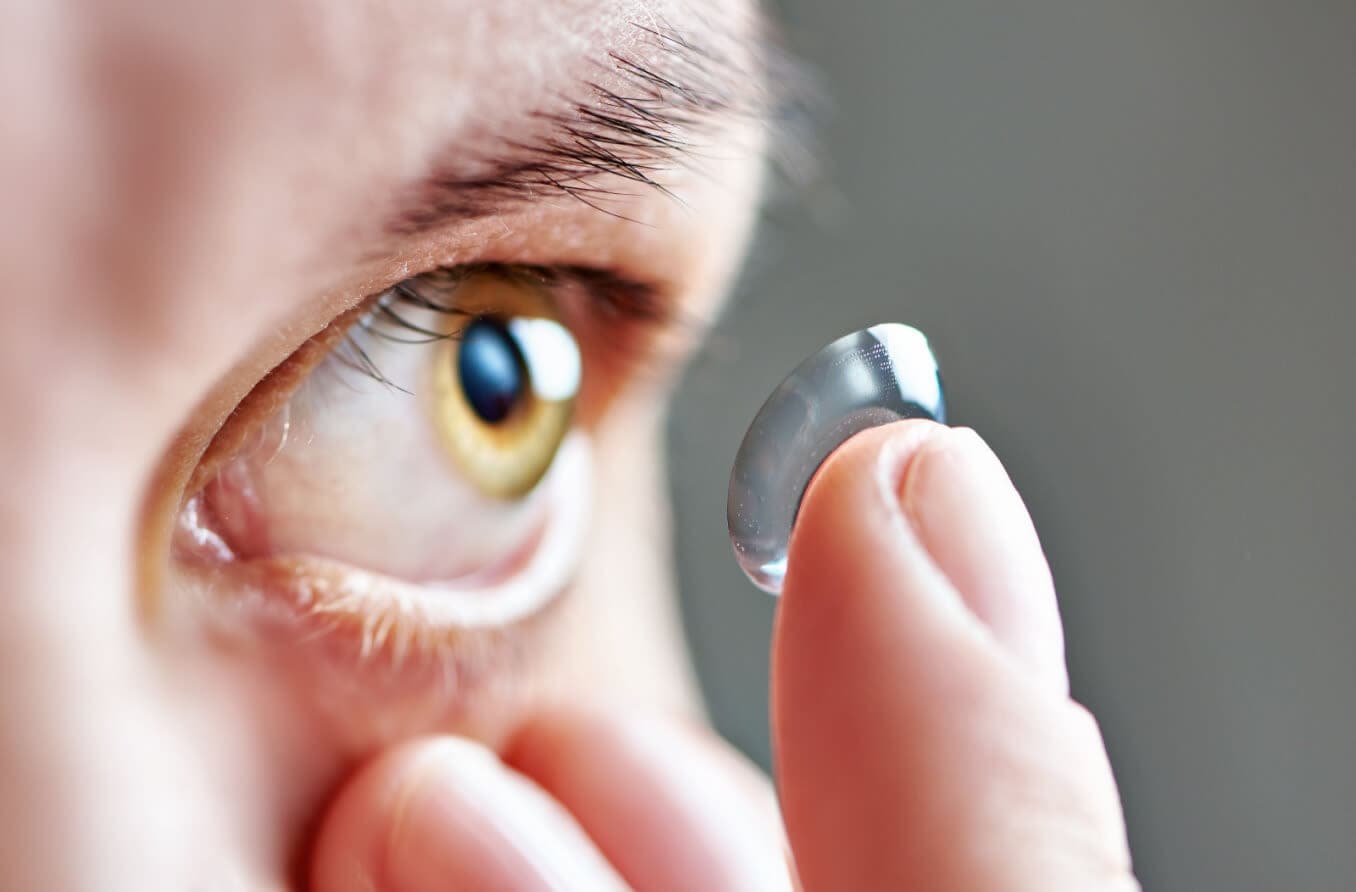
Contact lenses for presbyopia
Bifocal rigid gas permeable (GP) lenses and multifocal lenses (soft contact and GP) are designed to provide clear vision at all distances for people who have refractive errors and also are experiencing the normal age-related decline in near vision called presbyopia.
The main sign that you're developing presbyopia — which typically becomes noticeable sometime just before or after age 40 — is that you need to hold your phone, magazines and other reading material farther from your eyes in order to see them clearly.
Bifocal lenses come in a GP material while multifocal contact lenses come in both soft and GP materials. Some soft contact lenses can be worn on a disposable basis. That means you have the convenience of throwing the lenses out at specified intervals (even daily, in some cases) and replacing them with fresh, new lenses.
Several lens manufacturers offer multifocal contact lenses made of silicone hydrogel material. These lenses can allow significantly more oxygen to reach the cornea than conventional soft lenses for greater wearing comfort and are available for both daily wear and extended wear.
Other options include hybrid contact lenses, which have a central optical zone made of GP lens material for crisp optics and a peripheral fitting zone made of soft silicone hydrogel material for comfort.
Bifocal contacts, multifocal contacts: What's the difference?
Bifocal contacts lenses have two prescriptions in the same lens. Multifocal contact lenses have a range of powers (similar to progressive eyeglass lenses) in each lens.
Multifocal contacts is also used as a catch-all term for all contact lenses with more than one power, including bifocal contacts.
How multifocal contact lenses work
Various bifocal and multifocal contact lens designs work in different ways, depending on the design of the lens. The designs fall into two basic groups:
- Simultaneous vision designs. These multifocal contact lenses have specific regions of the lens designated for far and near (and sometimes intermediate) viewing. Depending on the object being viewed, the wearer's eye uses the region(s) of the lens that provide the sharpest vision. There are two types of simultaneous vision designs: concentric and aspheric.
- Segmented designs. These rigid gas permeable multifocal lenses are designed much like bifocal and trifocal eyeglasses: the center and top portions of the lens contain the appropriate power for viewing distant objects, and the lower portion of the lens has added magnifying power for viewing near objects. Segmented designs sometimes are called alternating or translating designs.
Concentric multifocal contacts
Concentric multifocal lenses typically contain the lens power for seeing distant objects in the center of the lens, which is surrounded by concentric rings of near and distance powers of your contact lens prescription.
Typically, at least two concentric power rings are within your pupil area in normal lighting, but this varies as your pupil dilates and constricts due to varying light conditions.
Concentric multifocal lenses can be made of either soft or rigid gas permeable (RGP or GP) contact lens materials.
The locations of the powers in a concentric design can vary:
- GP multifocal lenses usually have the distance power in the center (called center-distance).
- Soft multifocal contact lenses sometimes have the near power in the center (center-near).
- Some concentric multifocal contacts have a center-distance design (D) for your dominant eye and a center-near design (N) for your non-dominant eye.

Aspheric multifocal contact lenses
The design of aspheric multifocal contact lenses is similar to that of progressive eyeglass lenses — there's a gradual change in power from far to near, with no visible lines in the lenses.
Unlike eyeglasses, however, aspheric multifocal contacts are simultaneous vision lenses, so your visual system must learn to select the proper lens power for the moment.
A number of aspheric multifocal contacts are available as daily disposable lenses for presbyopes.

Segmented bifocal contact lenses
Segmented bifocal contacts work much like bifocal eyeglass lenses. These rigid gas permeable (GP) contacts have two power segments, with an obvious line of separation between the distance correction on top and the near correction below. Your eye looks through either one or the other, depending on whether you're looking far or near.
With bifocal eyeglasses, this mechanism works because the lenses stay in place even as your eye moves. Unlike soft multifocal contact lenses (which move with your eyes), segmented GP bifocal contacts can be designed to stay in a certain position while your eye moves behind the lens.
Segmented GP lenses are smaller in diameter than soft contact lenses and rest on a layer of tears above the margin of your lower eyelid. Therefore, when your gaze shifts downward, the lens stays in place, allowing you to see through the lower, near-correction part of the lens.
Custom GP lenses also can be made with a segmented trifocal design, which includes a small, ribbon-shaped segment for intermediate vision, like trifocal eyeglass lenses.

Will multifocal contact lenses work for me?
Multifocal contact lenses have been around for many years, but until recently they weren't as popular.
Older multifocal designs didn't satisfy many people, leading to frustration among wearers and prescribers alike.
Today, new technology has produced more successful designs, as well as a greater variety of options. So if one design doesn't work for you, another might.
Your eye care provider may also try these related techniques:
- Monovision involves using single-vision lenses to put your near prescription on one eye and your distance prescription on the other.
- Modified monovision uses a single-vision lens on one eye and a multifocal lens on the other.
If multifocal contact lenses or monovision contacts don't provide adequate vision at all distances for you, an effective alternative is to wear eyeglasses with progressive lenses over your contact lenses when needed. Many contact lens wearers prefer wearing glasses with progressive lenses rather than reading glasses because:
- Full-size eyeglasses with progressive lenses can feel more youthful-looking than store-bought "readers."
- Progressive lenses should be able to correct mild residual astigmatism or other refractive error not fully corrected by your contacts. For this reason, eyeglasses with progressive lenses may give you sharper vision for specific activities like night driving.
- Progressive lenses allow you to see more clearly at all distances without having to constantly put on and take off reading glasses.
Which multifocal contact lens is right for me?
Two factors that your eye doctor will consider in choosing a multifocal contact lens are pupil size and your "add," or near prescription.
There are no hard and fast rules. But, in general, aspheric multifocal contact lenses tend to work well for mild to moderate presbyopia, and concentric multifocal lenses or segmented GP bifocal lenses often are more successful for advanced presbyopia.
You may need to try different multifocal contact lens designs before finding the one that's right for you. The cost of trial lenses is typically included in the cost of a multifocal contact lens fitting.
Because fitting multifocal contacts usually takes more time and requires more expertise than fitting regular contact lenses, you should expect to pay more to be fitted with these premium lenses. The cost of replacement lenses will be higher as well.
See your eye doctor to determine if multifocal contact lenses make sense for your needs and to identify the optimal lenses for you.
Nancy Del Pizzo also contributed to this article.