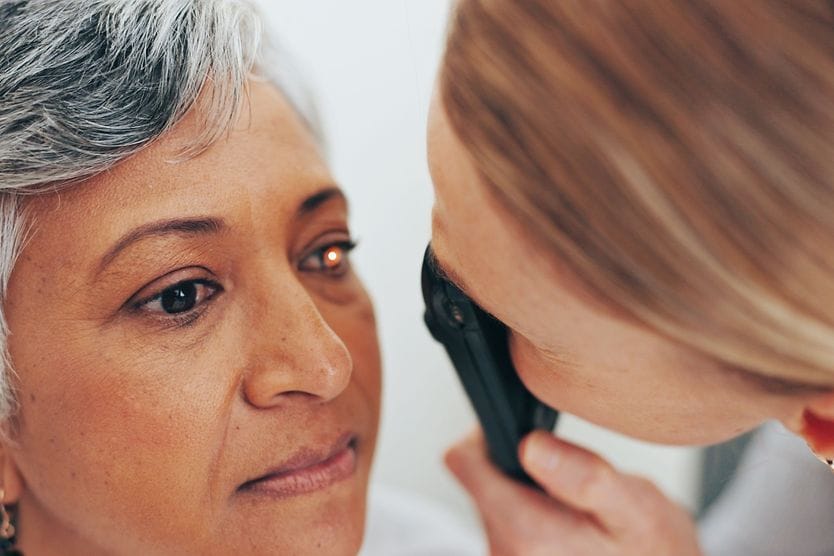
Signs and symptoms of age-related eye problems
As you age, your eyes naturally change, but it's important to be aware of the warning signs that may indicate a more serious issue. By recognizing these signs early, you can help protect your vision and prevent permanent damage. When it comes to eye health, early detection and treatment are critical.
Presbyopia is a common vision change that naturally occurs as you age. It is not a sign of any underlying eye disease. It happens because the lens in your eyes gradually loses its flexibility, making it harder to focus on close-up objects. Many people start to notice changes in their vision in their 40s. Reading glasses or multifocal lenses can help people with presbyopia see clearly up close.
That said, the risk of developing age-related eye problems increases significantly as you get older. Some vision changes may develop gradually and seem minor at first, while others can occur suddenly and require prompt medical attention. It’s important to understand which symptoms require an urgent visit to your eye doctor.
1. A sudden onset of many spots and floaters in your field of vision
Floaters are small shapes that can be seen drifting in your vision. They may look like tiny dots, strands, wavy lines or even web-like patterns.
More about the signs and symptoms
As you age, the clear, gel-like substance in the eye — the vitreous — begins to shrink and detach from the retina, the light-sensitive layer at the back of the eye. During this separation, tiny clumps of the gel may form and cast shadows on the retina, leading to the appearance of floaters in your vision. While they can be distracting, floaters are common in the aging process.
If you try to focus on them directly, they often seem to move away, continuing to float even when your eyes are not moving. Many people find it easier to notice floaters when looking at lighter backgrounds. While they can be distracting, they are typically harmless.
Retinal tear or retinal detachment
Most floaters are completely harmless and something many people experience. However, if you suddenly notice a large number of new floaters — especially if they're accompanied by light flashes or dark spots that affect your vision — it's important to seek medical attention right away. These symptoms could indicate a more serious issue, such as a retinal tear or retinal detachment.
Retinal detachment is a serious condition in which the retina, the light-sensitive tissue at the back of the eye, pulls away from its normal position. This is a medical emergency and can lead to permanent vision loss.
2. A sensation that a dark curtain has settled across your field of view
If you notice a dark shadow or veil come across your vision, it could also be a sign of retinal detachment.
More about the signs and symptoms
The darkened area typically begins in your peripheral vision and slowly moves toward the center of your field of vision. Many people describe this sensation as a grayish film or dark curtain that gradually obscures what they see. This affected region corresponds to the specific location where the retina has become detached.
Retinal detachment
A retinal detachment disrupts the blood flow that nourishes retinal tissue. Without prompt treatment and reattachment, this could lead to permanent damage and vision loss. Delays in treatment can lead to further separation of the retinal tissue, which may reduce the likelihood of restoring your vision completely. It's important to seek immediate medical attention if you experience this symptom.
3. Sudden eye pain, redness, nausea and vomiting
Acute angle-closure glaucoma is a serious condition that can cause sudden, severe eye pain and redness, nausea, and vomiting. It often appears unexpectedly.
More about the signs and symptoms
Many people describe the eye pain as intense, and it may spread to the forehead or facial area. Eye redness can occur because increased pressure causes the blood vessels on the surface of your eye to expand, making them more visible. Many people with acute angle-closure glaucoma may also feel intense nausea and stomach discomfort. If you experience these symptoms, it’s important to seek medical attention promptly.
Additional signs to be aware of include seeing halos or rainbow-like circles around lights, experiencing cloudiness in your vision, and having headaches. You might also notice that your pupil, which is the dark center of your eye, appears larger than normal.
Acute angle-closure glaucoma
Acute angle-closure glaucoma occurs when the fluid in your eye cannot drain properly, leading to a rapid increase in pressure. This can be due to many factors. The most common is a narrow angle where the fluid drains between the cornea and iris. This condition is a medical emergency and could lead to permanent vision damage if not treated right away.
4. Double vision, double images or "ghost" images
Diplopia, commonly known as double vision, is when you see two images of the same object.
More about the signs and symptoms
You might notice duplicate images appearing next to each other, stacked on top of one another, or at various angles. Double images may occur only occasionally, appearing up close or at a distance.
Issues with eye muscles, nerves or the brain
Double vision can be caused by issues with the cornea or lens of your eye. But as you age, new double vision is often linked to weakened eye muscles or issues with the nerves that control eye movements. It occurs when the eyes struggle to work together, preventing the brain from combining the images into one clear picture. Conditions such as diabetes, high blood pressure and strokes can lead to complications that cause double vision.
Conditions such as a brain aneurysm, tumor or multiple sclerosis may also lead to sudden double vision. If you experience diplopia alongside symptoms such as muscle weakness, numbness, difficulty speaking or a severe headache, it’s important to seek emergency medical help right away.
5. Sudden blind spot in one eye
A sudden appearance of a blank area in one eye can be scary. It can also signal a serious eye condition, such as diabetic retinopathy. This eye problem can affect anyone with diabetes, whether it's type 1, type 2 or pregnancy-related.
More about the signs and symptoms
Diabetic retinopathy occurs when abnormal blood vessels develop in the retina, leading to leakage into the vitreous, the gel-like substance inside your eyeball. This leakage can block light from reaching the retina, creating dark spots or areas where your vision is affected. At first, you may notice that these blind spots in your vision appear and then disappear. Without treatment, these spots can ultimately become larger blank areas in your vision.
Diabetic retinopathy
High blood sugar levels can gradually harm the blood vessels in the retina. The risk of diabetic retinopathy tends to increase the longer a person has diabetes. In fact, more than half of individuals living with diabetes may experience some form of diabetic retinopathy during their lifetime.
Occasionally, the leakage may stop on its own, and you might experience temporary improvements. However, without appropriate treatment, increased or recurrent bleeding from blood vessels can result in scarring in the back of the eye. This can lead to visual impairment due to the expansion of the blind spot. Managing diabetes can help prevent or delay eye complications.
6. A narrowing of your field of view
The gradual loss of side vision while your central vision remains clear is often the result of glaucoma. This is a progressive eye disease that affects peripheral vision. If you have diabetes, your risk of developing open-angle glaucoma, the most common form of this condition, nearly doubles.
More about the signs and symptoms
Vision changes can be subtle and may go unnoticed until they have a more serious impact on your daily life. If you're driving, for example, you might find it challenging to see objects beside you or notice vehicles coming from the side. A narrowing of your field of view can create a tunnel-like effect. What you can see is mostly limited to what’s directly in front of you.

Glaucoma
Glaucoma is a condition that affects the optic nerve, the pathway that transmits visual information from your eyes to your brain. Glaucoma gradually damages the optic nerve fibers, starting with your peripheral vision. High pressure inside the eyes is a major risk factor for glaucoma.
It's important to recognize that advanced glaucoma can lead to serious vision issues, including complete blindness. Regular eye exams can help detect glaucoma changes early, allowing you to start treatment early and reduce the risk of vision loss.
7. A gray, blurry or distorted spot in the center of your visual field
Age-related macular degeneration (AMD) is a leading cause of vision loss in people over 50. It’s a condition that affects your central vision, often leading to missing or distorted areas. An Amsler grid can help monitor changes in central vision.
More about the signs and symptoms
In its early stages, AMD often doesn't present obvious symptoms. This makes it easy to overlook changes in your vision for some time. In the late stages of AMD, you may experience vision changes. Straight lines might appear bent or distorted, and you may notice a gradual haziness in the center of your sight. This hazy area can expand over time, leading to blank spots in your vision.
Additionally, colors may not seem as bright as they once did, and you might find it increasingly difficult to see in low lighting. This can make everyday activities such as reading, driving, recognizing faces and preparing meals more challenging.
Age-related macular degeneration
Macular degeneration is a common eye condition that affects the macula. The macula is the central part of your retina responsible for clear, detailed vision. As you age, this area can gradually deteriorate. In the early stages of AMD, small fatty deposits called drusen may accumulate beneath the retina's outer layer. These deposits can disrupt the natural flow of nutrients and waste, leading to damage.
For some, the AMD progresses slowly, while for others, it may advance more rapidly. As the condition progresses, the light-sensitive cells in your macula, known as photoreceptors, may begin to break down and die, leading to blurry or distorted central vision. Often, your side (peripheral) vision remains intact. The rate of progression varies. For some, it may take years. For others, the decline can occur more quickly, potentially leading to a significant loss of central vision if left untreated.
In more advanced stages, abnormal blood vessels may grow beneath the retina. These fragile vessels can leak blood and fluid, leading to sudden changes in your vision and potentially causing further damage to the healthy cells in the macula. This is called “wet AMD” because of the leaking blood vessels. It is less common but more severe than “dry AMD,” which accounts for about 80% of cases.
8. Poor night vision, halos around lights or less vivid color vision
A cataract is a clouding of the lens in your eye that can affect your vision. While cataracts can start at any age, they typically begin to develop around age 40 and progress gradually. They're one of the most common age-related eye problems.
More about the signs and symptoms
You may notice that your vision is hazy and that seeing in dim light has become more difficult. Car headlights can cause significant glare. As a result, driving at night may become more challenging.

Indoor lighting and sunlight can also feel overly bright and uncomfortable. You may notice halos surrounding lights at night. Colors may seem washed out or take on a yellowish tint. This can make it difficult to distinguish between similar shades, such as dark blue and black.
Cataracts
Cataracts can cause light to scatter as it enters your eyes. Cataracts occur when the proteins in the lens of the eye start to break down and form clumps, leading to cloudy areas that can affect vision.
Surgery is the only way to remove cataracts. However, people often wait before opting for surgery. Improving home lighting, wearing sunglasses to reduce glare or getting a new pair of prescription glasses can be beneficial during the early stages of cataracts.
9. Blurred vision and gray areas in your visual field
When diabetes damages the blood vessels in your retina, it can cause fluid buildup in the macula, which is essential for clear central vision. Cloudy vision along with grayish patches could be a sign of diabetic macular edema (DME). This condition is associated with diabetic retinopathy.
More about the signs and symptoms
You might notice that your vision is blurry with gray areas. You may see double images of objects. Many people also experience small floating shapes drifting across their vision, and colors may seem less bright or vibrant than they once were.
Some individuals report dark spots obscuring parts of their sight, while others notice that straight lines appear wavy or bent. Bright lights or glare may become more uncomfortable or distracting. Objects may appear different sizes when viewed with one eye than when viewed with both eyes together.
Diabetic macular edema
This condition occurs when blood vessels in your retina leak fluid into the macula, the part of your eye responsible for clear central vision. The leakage can lead to swelling and a hazy appearance in your vision. Managing diabetes, blood pressure and cholesterol can significantly reduce the risk of developing this condition.
10. Red, "scratchy," irritated eyes
Dry eye syndrome can cause an uncomfortable feeling, like having tiny particles in your eyes. This can be an age-related problem, as it tends to become more frequent after age 50. It's more common in women than in men.
More about the signs and symptoms
You may notice stinging or burning sensations in your eyes. Additionally, your eyes might appear red and feel sensitive to light. Your vision may also appear blurry.
Dry eye syndrome
Dry eye syndrome occurs when your eyes don’t produce enough tears to keep them adequately moisturized or when your tears evaporate too quickly. Your eyes might respond by producing excessive tears to compensate. However, these tears are not the right type to keep your eyes moistened.
Dry eye can result from various factors. Spending extended periods looking at screens, such as computers, tablets or smartphones, often leads to reduced blinking. This lack of blinking can cause tears to evaporate more quickly, resulting in dryness. Additionally, some medications may have dry eye as a side effect. Certain autoimmune conditions can also make individuals more susceptible to dry eye.
Treatment for dry eyes often starts with artificial tears to provide relief. For more serious cases, eye doctors may prescribe eye drops to help the eyes produce more tears. Using a humidifier, taking regular breaks from screen time, staying well-hydrated and getting adequate sleep can also help improve symptoms.
Preventing age-related eye problems
As you age, it's important to take steps to protect your vision:
- Wear sunglasses that provide 100% ultraviolet (UV) protection.
- Stop tobacco use, as it can increase the risk of macular degeneration and cataracts.
- Support your eye health by eating a balanced diet rich in nutritious foods. Focus on including dark green leafy vegetables like spinach and kale, as well as omega-3-rich foods.
Staying active also lowers the risk of health issues, such as diabetes and high blood pressure, which can lead to eye complications. If you already have these conditions, take steps to manage them. Follow your doctor's treatment plan, take your medications as prescribed, and regularly check your blood glucose and/or blood pressure.
See an eye doctor regularly
Scheduling an eye exam at an ophthalmology or optometry office is one of the best ways to maintain your eye health. Remember that some eye problems may not show any symptoms initially. Routine eye exams allow your doctor to identify potential eye issues early, when they are easiest to treat. If you are 65 or older, doctors recommend a dilated eye exam every year to check for common age-related eye conditions.
If you notice sudden changes in your vision, such as a flurry of new floaters, flashes of light, a dark spot moving across your field of vision, or significant eye pain accompanied by nausea, it’s important to seek medical attention right away. These symptoms could indicate a serious condition that requires immediate treatment.
READ NEXT: Eye exams for senior