Higher-order aberrations (HOAs) are more subtle and complex refractive errors compared to nearsightedness, farsightedness and astigmatism. Because of their complex nature, these aberrations cannot be corrected with regular eyeglasses and most contact lenses.
If your eye doctor has special equipment in their office required to detect HOAs and says you have a significant amount of these aberrations, you may wonder exactly what this means and what impact — if any — it has on the quality of your vision.
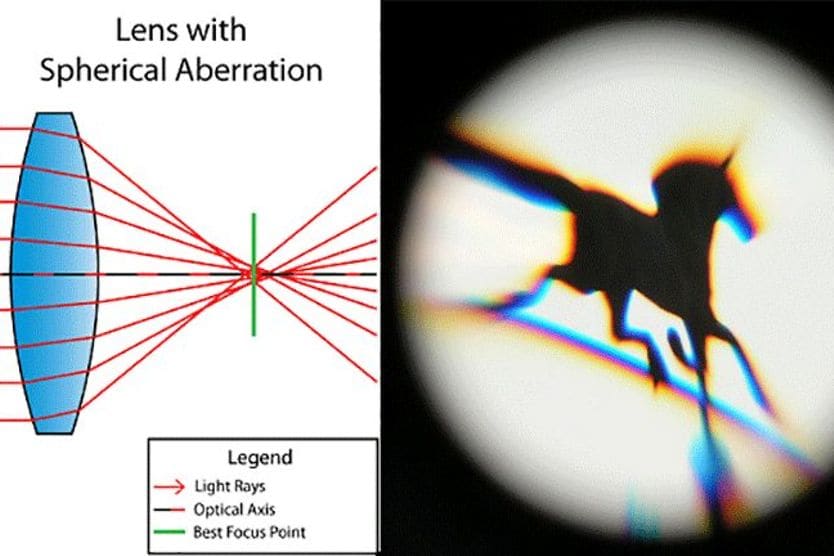
Higher-order aberrations have relatively unfamiliar names — such as coma, spherical aberration and trefoil. These aberrations can cause difficulty seeing at night, glare, halos, blurring, starburst patterns or double vision (diplopia).
No eye is perfect, which means that all eyes have at least some degree of higher-order aberrations. If you are diagnosed with higher-order aberrations, it usually isn't cause for concern unless they are significant enough to cause vision symptoms. In this case, an eye doctor can help you find ways to reduce the symptoms.
What exactly is a higher-order aberration?
A higher-order aberration is a distortion acquired by a wavefront of light when it passes through an eye with irregularities of its refractive components (tear film, cornea, aqueous humor, crystalline lens and vitreous humor).
Abnormal curvature of the cornea and crystalline lens may contribute to the distortion acquired by a wavefront of light. Serious higher-order aberrations also can occur from scarring of the cornea from eye surgery, trauma or disease.
Cataracts clouding the eye's natural lens also can cause higher-order aberrations. Aberrations also may result when dry eye diminishes your eye's tear film, which helps bend or refract light rays to achieve focus.
Common wavefront shapes (aberrations)

Image Credit: Resan M, Vukosavljević M, Milivojević M. "Wavefront Aberrations." In: Ophthalmology — Current Clinical and Research Updates. IntechOpen; 2014. DOI: 10.5772/53986. Chapter ID: 31125
This chart reveals more common shapes of aberrations created when a wavefront of light passes through eyes with imperfect vision. A theoretically perfect eye (top) is represented by an aberration-free flat plane known, for reference, as piston.
How are higher-order aberrations diagnosed?
Higher-order aberrations are identified by the types of distortions acquired by a wavefront of light as it passes through your eye.
Because no eye is optically perfect, a uniform wavefront of light rays passing through an eye acquires certain three-dimensional, distorted shapes.
Two categories of aberrations commonly are used to describe refractive errors of the eye:
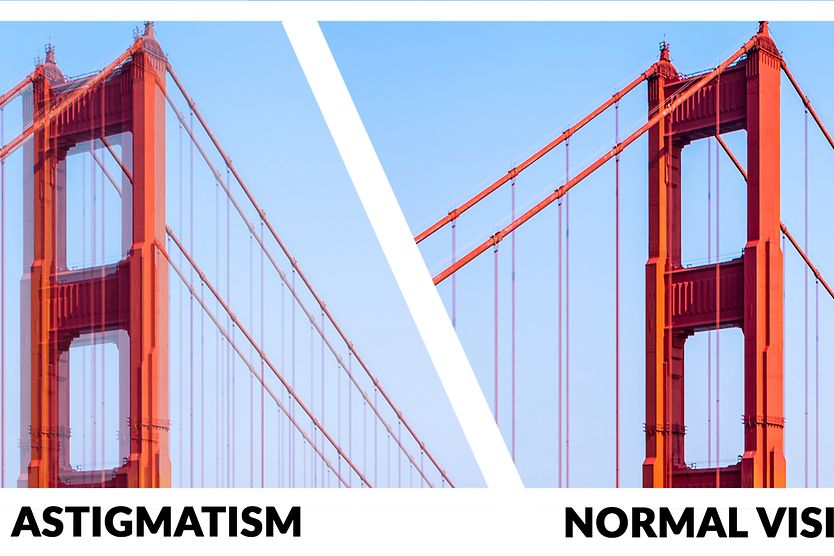
- Lower-order aberrations consist primarily of nearsightedness and farsightedness (defocus), as well as astigmatism. They make up about 85 percent of all aberrations in an eye.
- Higher-order aberrations comprise many varieties of aberrations. Some of them have names such as coma, trefoil and spherical aberration, but many more of them are identified only by mathematical expressions (Zernike polynomials). They make up about 15 percent of the total number of aberrations in an eye.
Order refers to the complexity of the shape of the wavefront emerging through the pupil — the more complex the shape, the higher the order of aberration.
What impact do higher-order aberrations have on vision quality?
The impact of higher-order aberrations on vision quality depends on various factors, including the underlying cause of the aberration.
People with larger pupil sizes generally may have more problems with vision symptoms caused by higher-order aberrations, particularly in low lighting conditions when the pupil opens even wider.
But even people with small or moderate pupils can have significant vision problems when higher-order aberrations are caused by conditions such as scarring of the eye's front surface (cornea) or cataracts that cloud the eye's natural lens. Also, specific types and orientation of higher-order aberrations have been found in some studies to affect vision quality of eyes with smaller pupils.
Large amounts of certain higher-order aberrations can have a severe, even disabling, impact on vision quality.
What symptoms are associated with higher-order aberrations?
An eye usually has several different higher-order aberrations interacting together. Therefore, a correlation between a particular higher-order aberration and a specific symptom cannot easily be drawn. Nevertheless, higher-order aberrations are generally associated with:
Double vision
Blurriness
Ghost images
Halos
Starbursts
Loss of contrast
Poor night vision
Can higher-order aberrations be corrected?
Quite a bit of attention is being focused on higher-order aberrations these days because they finally can be diagnosed by wavefront technology (aberrometry) and because they recently have been identified as sometimes serious side effects of refractive surgery.
At present, various forms of adaptive optics have been or are being developed to custom correct higher-order aberrations. These include new kinds of spectacles, contact lenses, intraocular lenses and refractive surgery, which modifies the shape of the eye's surface or cornea.
The aim of adaptive optics is to achieve the type of vision correction that can make flatter the shape of the wavefront emerging in the plane of the pupil by offsetting its distortion.
However, adaptive optics may be unable to pinpoint specific physical imperfections of refractive components of the eye that cause these distortions in the first place.
READ MORE: High-definition eyeglass lenses and wavefront or custom LASIK